mahapratisaravidyavidhi. the spell- manual of the great amulet
Mahāpratisarāvidyāvidhi, a rediscovered Sanskrit text, represents a crucial spell-manual detailing the creation of the “Great Amulet” for potent protective rituals.
Historical Significance
Historically, the Mahāpratisarāvidyāvidhi held immense importance as a practical guide for Vajrayana Buddhist practitioners seeking protection. Considered lost for centuries in Sanskrit, its rediscovery in 2010 with the Codex Unicus dramatically altered scholarly understanding.
Prior to this, knowledge of the ritual practices surrounding Mahapratisara relied heavily on fragmented sources like the Gilgit manuscripts and Eastern Indian/Nepalese texts. The Mahāpratisarāvidyāvidhi provides a complete, coherent Sanskrit version, offering invaluable insight into the evolution of these protective practices.
Its emergence signifies a pivotal moment in the study of Buddhist tantra, allowing researchers to analyze the text’s influence and its place within the broader landscape of apotropaic literature. The manual’s detailed instructions illuminate the historical methods employed to ward off negative influences.
The Text’s Place in Vajrayana Buddhism
Within Vajrayana Buddhism, the Mahāpratisarāvidyāvidhi occupies a unique position as a dedicated ritual manual for enacting protective practices centered on Mahapratisara. It’s not a philosophical treatise, but a practical guide detailing the steps to create a potent amulet and protective circle.
This text demonstrates the importance of ritual action and visualization within the Vajrayana tradition, emphasizing the power of skillful means to overcome obstacles. The Mahāpratisarāvidyāvidhi complements broader Vajrayana teachings on deities and mantras, providing a specific application for harnessing their power.
Its focus on apotropaic function highlights a key aspect of Vajrayana – safeguarding practitioners from harmful forces. The manual’s rediscovery enriches our understanding of how these protective techniques were historically implemented and integrated into the broader Buddhist worldview.
Overview of the “Great Amulet” Title
The designation “Great Amulet, Great Queen of Spells” (Mahapratisara-Mahavidyarajni) encapsulates the text’s core purpose: providing a method for creating a powerful protective device. The “Great Amulet” isn’t merely a physical object, but a manifestation of Mahapratisara’s protective energy, activated through precise ritual procedures detailed in the Mahāpratisarāvidyāvidhi.
The title emphasizes both the amulet’s efficacy – its “greatness” in warding off evil – and Mahapratisara’s authority as a powerful female deity, a “queen” commanding magical forces. This reflects a broader Vajrayana emphasis on female deities and their roles in protection and empowerment.
The “spell” component highlights the text’s function as a manual for enacting potent rituals, transforming intention and visualization into tangible protective power. It’s a key to unlocking Mahapratisara’s benevolent influence.

Sources and Manuscript Traditions
The Mahāpratisarāvidyāvidhi, once considered lost, was rediscovered in 2010 within a Codex Unicus, forming a vital source for study.
Gilgit Fragments – A Primary Source
The Gilgit fragments represent an early, significant source for understanding the Mahapratisara-Mahavidyarajni tradition, though not directly containing the Mahāpratisarāvidyāvidhi itself. Gergely Hidas’s critical edition meticulously examines these fragments, providing foundational textual data. These fragments illuminate the broader context within which the amulet-creation manual developed, revealing earlier iterations of related concepts and practices.
While the complete ritual manual was absent from the initial Gilgit discoveries, the fragments offer invaluable insights into the textual milieu. They demonstrate the circulation of Mahayana Buddhist texts in the region and the evolving nature of Vajrayana practices. The fragments’ analysis aids in reconstructing the historical development of the Mahapratisara tradition, establishing a crucial baseline for comparative study with later manuscripts, including the rediscovered Codex Unicus containing the Mahāpratisarāvidyāvidhi.
Eastern Indian and Nepalese Manuscripts
Eastern Indian and Nepalese manuscripts provide further crucial evidence for tracing the transmission and evolution of the Mahapratisara-Mahavidyarajni tradition, complementing the Gilgit fragments. Gergely Hidas’s research details a critical edition of selected manuscripts from these regions, revealing textual variations and additions. These sources, predating the 2010 Codex Unicus discovery, offer valuable comparative material for understanding the development of the Mahāpratisarāvidyāvidhi—the amulet-creation manual.
Analysis of these manuscripts demonstrates the regional adaptations of the Mahapratisara practices. They showcase the diverse ways in which the protective spells and amulet-making techniques were understood and implemented across different Buddhist communities. The textual traditions preserved within these manuscripts illuminate the broader network of Buddhist scholarship and practice in Eastern India and Nepal, enriching our understanding of the text’s historical context.
The Codex Unicus – Sanskrit Rediscovery (2010)
Prior to 2010, the Mahāpratisarāvidyāvidhi, the spell-manual detailing the creation of the Great Amulet, was considered lost in its original Sanskrit form. This dramatically changed with the astonishing discovery of a Codex Unicus – a unique manuscript containing the complete text. Published in Acta Orientalia Academiae Scientiarum Hungaricae, this find enabled the first critical edition and translation of the work.
The Codex Unicus provided scholars with a primary source for understanding the precise ritual instructions for preparing a protective circle and crafting the Mahāpratisarā amulet. This rediscovery was a landmark moment in the study of Mahayana Vajrayana Buddhism, offering direct access to a previously inaccessible component of its apotropaic practices and significantly advancing research into the text’s origins and influence.
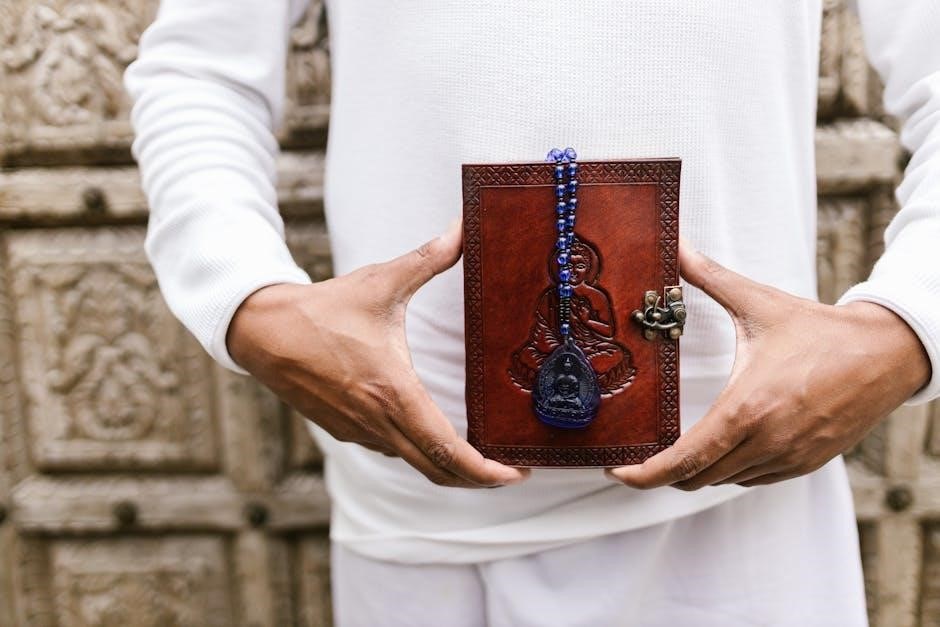
Structure and Content of the Text
The Mahāpratisarāvidyāvidhi meticulously details ritual procedures, focusing on preparing protective circles and crafting the amulet for warding off negative influences.
Organization of the Mahapratisara-Mahavidyarajni
The Mahāpratisarāvidyāvidhi, discovered as a Codex Unicus in 2010, exhibits a concise yet focused organizational structure. Unlike broader scriptures, this text functions primarily as a ritual manual, dedicating itself almost entirely to the practical aspects of amulet creation and associated protective rites. It’s presented as a direct guide, eschewing extensive narrative framing or philosophical discourse.
The text’s organization centers around the step-by-step instructions for establishing a sacred space – the protective circle – and then the detailed procedures for constructing the amulet itself. This includes specific mantras, visualizations, and material requirements. The manual’s brevity suggests a highly standardized and codified ritual practice, intended for practitioners already familiar with basic Vajrayana principles. It’s a focused document, prioritizing efficacy and precision over elaborate exposition.
Core Sections and Their Focus
The Mahāpratisarāvidyāvidhi’s core is divided into distinct sections, each addressing a critical stage of the amulet’s creation and activation. The initial portion meticulously details the preparation of the protective circle, outlining the necessary geometric construction and the accompanying mantra recitation to consecrate the space. This establishes a secure environment for the ritual.
Subsequently, the text focuses on the amulet itself, providing precise instructions for its physical creation – materials, form, and inscription of seed syllables. A significant section is dedicated to the visualization practices and mantras required to infuse the amulet with Mahapratisara’s protective energy. The final part likely concerns the consecration and empowerment of the amulet, preparing it for use as a potent apotropaic device. Each section is tightly focused, reflecting the manual’s practical intent.
Relationship to Other Buddhist Texts
The Mahāpratisarāvidyāvidhi, while a distinct ritual manual, exists within a broader network of Buddhist texts concerning protective practices and deity yoga. Its focus on Mahapratisara links it to tantric traditions emphasizing female deities as powerful protectors. The text likely draws upon foundational tantric literature outlining visualization techniques and mantra practices common across various Buddhist schools.
Furthermore, connections can be traced to broader Mahayana sutras emphasizing the bodhisattva path and the importance of compassion in overcoming obstacles. While not directly cited, the underlying philosophical framework aligns with Mahayana principles. The Mahapratisara-Mahavidyarajni, the larger text containing the vidyavidhi, provides crucial context, illustrating the narratives and moral perfections that underpin the ritual’s efficacy, drawing from sources like the Mahabharata.

The Six Perfections (Paramitas) and Narrative Context
Legends illustrating the six perfections—giving, morality, forbearance, striving, meditation, and wisdom—provide the narrative foundation for the amulet’s power and efficacy.
Legends Illustrating Generosity (Dana Paramita)
The Mahapratisara-Mahavidyarajni incorporates legends designed to exemplify the perfection of generosity, or Dana Paramita. These narratives aren’t solely drawn from established Buddhist sources; Haribhatta, the text’s author, creatively integrates tales from diverse origins, including the epic Mahabharata and even prevalent folk stories of the time.
This demonstrates a deliberate broadening of the textual scope, enriching the illustrative power of the paramitas. The inclusion of non-Buddhist narratives suggests an intent to resonate with a wider audience and underscore the universal value of selfless giving.
Haribhatta, unlike his predecessor Aryasura, actively adapts and alters original plotlines to heighten dramatic impact, ensuring the legends effectively convey the profound significance of generosity within the context of the amulet’s protective power.
Legends Illustrating Morality (Sila Paramita)
Within the Mahapratisara-Mahavidyarajni, legends embodying the perfection of morality, Sila Paramita, serve as crucial didactic elements. Similar to the narratives illustrating generosity, these stories aren’t confined to purely Buddhist origins. Haribhatta skillfully weaves in tales from a broad spectrum of sources, including the expansive Mahabharata and even contemporary folk traditions.
This eclectic approach highlights the universality of ethical conduct, demonstrating that moral principles transcend specific religious boundaries. Haribhatta’s willingness to adapt and reshape original narratives, diverging from Aryasura’s approach, underscores his commitment to dramatic effect and impactful storytelling.
These alterations ensure the legends powerfully convey the importance of ethical behavior as a foundational element in the amulet’s protective efficacy and the practitioner’s spiritual journey.
Legends Illustrating Forbearance (Ksanti Paramita)
The Mahapratisara-Mahavidyarajni utilizes legends embodying Ksanti Paramita – the perfection of forbearance – to demonstrate resilience and equanimity. Like the narratives for generosity and morality, these tales aren’t exclusively sourced from Buddhist literature; Haribhatta draws from diverse origins, including the Mahabharata and even popular folklore.
This inclusive selection emphasizes the universal relevance of patience and tolerance. Haribhatta’s distinctive approach, differing from Aryasura, involves bold alterations to original plots, prioritizing dramatic impact and emotional resonance. These modifications aren’t arbitrary; they serve to amplify the lessons of forbearance.
The stories powerfully illustrate how enduring hardship and maintaining composure are vital components of the amulet’s protective power and the practitioner’s spiritual development.

Haribhatta’s Adaptations and Dramatic Effects
Haribhatta, unlike Aryasura, embraced playwright techniques, boldly altering original narratives within the Mahapratisara-Mahavidyarajni to heighten dramatic intensity and impact.
Comparison with Aryasura’s Work
A striking divergence emerges when comparing Haribhatta’s approach to that of his predecessor, Aryasura. While both authors engage with the Mahapratisara-Mahavidyarajni tradition, their methodologies differ significantly. Aryasura’s style remains relatively faithful to established narratives, prioritizing preservation of the original stories.
Haribhatta, however, actively departs from this convention. He consciously adopts the techniques of a playwright, demonstrating a willingness to dramatically alter original plots. This isn’t merely a matter of stylistic preference; it’s a deliberate strategy to amplify the emotional and dramatic resonance of the text. He isn’t constrained by a need to adhere strictly to source material, instead prioritizing impactful storytelling.
This contrast is particularly evident in the legends illustrating the six perfections (paramitas). Haribhatta doesn’t hesitate to modify existing tales or even incorporate narratives from diverse sources—like the Mahabharata or folk traditions—to achieve a more compelling effect. This bold adaptation sets his work apart, showcasing a unique creative vision within the broader Mahapratisara literature;
Playwright Techniques in the Text
Haribhatta’s Mahapratisara-Mahavidyarajni demonstrably employs techniques borrowed directly from the world of dramatic arts. This is not simply a literary flourish, but a fundamental aspect of the text’s construction; He utilizes dramatic alterations to existing narratives, prioritizing emotional impact and heightened tension over strict adherence to source material.
The author skillfully manipulates plot elements, introducing unexpected twists and turns to captivate the audience – or, in this case, the practitioner. This approach is reminiscent of a playwright crafting a compelling scene, building suspense and drawing the viewer into the unfolding events. The legends illustrating the six perfections are not presented as static accounts, but as dynamic performances.

In essence, Haribhatta transforms the traditional Buddhist narrative into a theatrical experience, leveraging the power of dramatic storytelling to enhance the potency and memorability of the Mahapratisara teachings. This innovative approach distinguishes his work and highlights his artistic ingenuity.
Alterations to Original Plots
Haribhatta, unlike his predecessor Aryasura, actively and boldly revises the foundational narratives within the Mahapratisara-Mahavidyarajni. These aren’t minor adjustments; they represent substantial alterations designed to amplify the dramatic effect and emotional resonance of the stories. He doesn’t hesitate to deviate from established Buddhist lore, drawing even from sources like the Mahabharata and folk tales to enrich his tapestry.
This willingness to reshape existing plots serves a clear purpose: to create a more compelling and engaging experience for the reader or practitioner. The alterations aren’t arbitrary; they are carefully calculated to heighten the impact of the six perfections (paramitas) being illustrated. By injecting novelty and surprise, Haribhatta ensures that the lessons are both memorable and deeply felt.
The Mahāpratisarāvidyāvidhi, while a ritual manual, benefits from this narrative dynamism, grounding the protective practices in emotionally charged stories.

The Ritual Manual Aspect – Mahāpratisarāvidyāvidhi
The Mahāpratisarāvidyāvidhi details precise steps for crafting a protective circle or amulet of Mahāpratisarā, newly discovered in a unique Sanskrit codex.
Purpose of the Rituals Described
The Mahāpratisarāvidyāvidhi’s core function is explicitly apotropaic – focused on warding off negative influences and ensuring protection for practitioners. This ritual manual provides detailed instructions for creating a powerful amulet embodying Mahāpratisarā’s protective energies. The rituals aren’t merely symbolic; they are designed to actively counteract harmful forces, be they supernatural or stemming from worldly challenges.
The text outlines a precise methodology for establishing a sacred space, preparing the necessary materials, and invoking the deity’s power. The ultimate aim is to generate a tangible object – the amulet – imbued with the ability to shield the bearer from misfortune, illness, and malevolent entities. Essentially, the manual serves as a practical guide to harnessing Buddhist tantric principles for immediate, real-world protection, offering a pathway to safety and well-being through dedicated practice.
Preparing the Protective Circle
The Mahāpratisarāvidyāvidhi meticulously details the construction of a protective circle, a foundational element of the amulet creation ritual. This isn’t a simple geometric drawing; it’s a sacred enclosure designed to contain and channel energies, safeguarding the practitioner and the ritual space from interference. The manual specifies precise procedures for demarcating the circle’s boundaries, often involving the use of specific substances and mantras.
Within this consecrated area, the ritual unfolds, shielded from disruptive forces. The circle acts as a microcosm of the cosmos, aligning the practitioner with beneficial energies and creating a conducive environment for invoking Mahāpratisarā’s power. Careful attention is given to the orientation and symbolism embedded within the circle’s design, ensuring its efficacy as a potent barrier against negativity and a focal point for protective energies.
Creating the Amulet
The Mahāpratisarāvidyāvidhi provides detailed instructions for crafting the amulet itself, transforming it into a vessel of Mahāpratisarā’s protective power. This process extends beyond mere physical construction; it involves a series of complex ritual actions and mantra recitations designed to infuse the amulet with spiritual potency. The manual likely specifies materials deemed auspicious and effective for attracting and holding protective energies.
Each step, from the selection of materials to the final consecration, is carefully prescribed to ensure the amulet’s efficacy. The creation isn’t simply about assembling components, but about imbuing the object with the deity’s presence. Once completed, the amulet serves as a tangible embodiment of Mahāpratisarā’s safeguarding influence, offering continuous protection to its bearer.

Critical Editions and Translations
The Mahāpratisarāvidyāvidhi saw its first critical edition and translation in 2010, based upon a unique Sanskrit Codex Unicus discovery;
Gergely Hidas’s Edition and Translation (2012)
Hidas’s 2012 publication, “Mahapratisara-Mahavidyarajni: The Great Amulet, Great Queen of Spells,” marks a landmark achievement, presenting the inaugural complete Western translation alongside a critical edition of this significant Vajrayana Buddhist scripture. This comprehensive volume meticulously examines sources, structure, and content, offering invaluable insights into the text’s complexities.
Included within Hidas’s work is a detailed critical edition of the Gilgit fragments, alongside selected Eastern Indian and Nepalese manuscripts, providing a robust textual basis for his translation. He also provides detailed annotations, abbreviations, symbols, and a thorough bibliography, enhancing the scholarly value of the work. This edition facilitates deeper understanding of the Mahāpratisarāvidyāvidhi’s role within broader Buddhist traditions and its practical applications.
Acta Orientalia Publication (2010)
The 2010 Acta Orientalia publication presented the first attempt at a critical edition and translation of the Mahāpratisarāvidyāvidhi, a previously considered lost Sanskrit tantric work. This article’s significance lies in its rediscovery of a Codex Unicus, forming the foundation for the presented edition.
The publication details the text’s nature as a ritual manual, specifically outlining procedures for creating a protective circle or amulet dedicated to Mahāpratisarā. This work illuminated the practical aspects of the “Great Amulet,” offering scholars a direct glimpse into the ritualistic applications of this powerful Buddhist practice. The publication’s timing marked a pivotal moment in the study of Mahayana Vajrayana Buddhism, opening new avenues for research and understanding.
Challenges in Translation and Interpretation
Translating the Mahāpratisarāvidyāvidhi presents unique challenges due to its highly technical and ritualistic language, deeply rooted in Vajrayana Buddhist cosmology and practice. Accurately conveying the nuances of Sanskrit terminology related to tantric procedures and protective circles requires specialized expertise.
Interpretation is further complicated by the text’s concise nature and reliance on implicit understandings within the tradition. Deciphering the precise meaning of ritual instructions and symbolic representations demands a thorough grasp of related Buddhist texts and practices. Establishing the historical context and intended audience also influences interpretation, demanding careful consideration of manuscript traditions and scholarly debates surrounding the “Great Amulet” and its protective function.

Apotropaic Function and Protective Practices
The Mahāpratisarāvidyāvidhi details creating an amulet—a potent device for warding off evil influences and ensuring comprehensive spiritual protection.
The Amulet as a Protective Device
The Mahāpratisarāvidyāvidhi meticulously outlines the procedures for crafting a powerful amulet centered around Mahapratisara. This isn’t merely a talisman; it’s a carefully constructed ritual object designed to function as a robust shield against negative energies and harmful influences. The manual details the precise steps for preparing a protective circle, essential for containing and directing the amulet’s power.
The creation process, as described in the rediscovered Sanskrit text, involves specific mantras, visualizations, and offerings; It’s a complex undertaking, signifying the seriousness with which protection is approached within this Vajrayana Buddhist tradition. The amulet serves as a focal point for channeling Mahapratisara’s protective energies, offering a tangible means of safeguarding oneself and others from adversity. Its efficacy relies heavily on the practitioner’s dedication and adherence to the prescribed ritual guidelines.

Warding Off Evil Influences
The Mahāpratisarāvidyāvidhi explicitly addresses the need to counteract malevolent forces, detailing how the amulet acts as a potent barrier against them. The text suggests that negative influences – stemming from spirits, curses, or unfavorable astrological alignments – can be effectively neutralized through the amulet’s protective aura. The ritual procedures outlined aren’t simply preventative; they actively dispel existing harmful energies.
The manual emphasizes the importance of visualization during the amulet’s creation, focusing on Mahapratisara’s power to overcome obstacles and vanquish negativity. Specific mantras are employed to invoke her protective presence, reinforcing the amulet’s ability to ward off evil. This isn’t a passive defense; it’s an active engagement with potentially harmful forces, utilizing the amulet as a conduit for transformative energy and spiritual resilience.
The Role of Mahapratisara in Protection
Mahapratisara, within the Mahāpratisarāvidyāvidhi, isn’t merely a deity invoked for assistance, but the very embodiment of protective power. The manual details how her essence is infused into the amulet during its creation, transforming it into a focal point for her compassionate strength. She’s depicted as a fierce protector, capable of swiftly and decisively neutralizing threats.
The rituals aren’t about supplication, but about establishing a direct connection with Mahapratisara’s energy. Mantras and visualizations serve to align the practitioner with her protective qualities, allowing her power to flow through the amulet. This creates a shield against negative influences, offering safety from both seen and unseen dangers. Her role is central to the amulet’s efficacy, making her the cornerstone of this protective practice.